

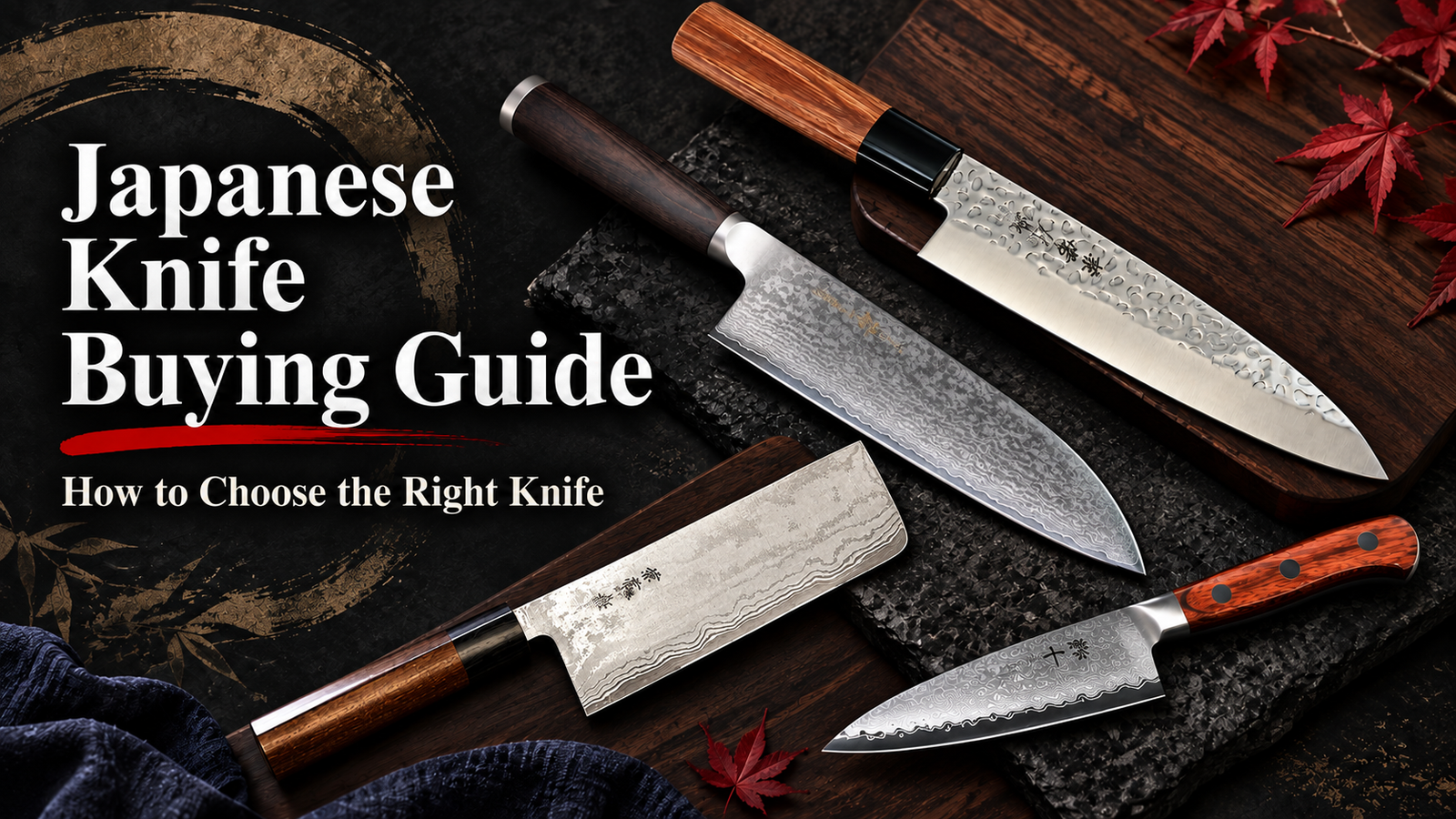
This Japanese knife buying guide covers the key decisions that matter most: knife type, blade length, steel, handle, maintenance, and budget.
This guide will help you compare those factors and narrow down the best option for your cooking style — whether you are buying your first Japanese knife or upgrading to something more specialized.
Table of Contents
Japanese Knife Buying Guide: What to Consider First
| Factor | Ask Yourself | Good Starting Point |
|---|---|---|
| Knife Type | What do I cook most often? | Gyuto or Santoku |
| Blade Length | Do I prefer reach or easier control? | 180–210mm |
| Steel | How much maintenance am I comfortable with? | Stainless steel |
| Handle | Which grip feels more natural? | Wa or Western style |
| Weight & Balance | Do I prefer light and agile or more substantial? | Prioritize comfort and control |
| Budget | What performance level do I actually need? | Buy for your needs, not the highest price |
For most first-time buyers, a stainless Gyuto or Santoku in a comfortable size is the simplest place to start. The sections below explain how to refine that choice.
Choose the Right Japanese Knife Type
Knife type should match the way you cook most often. For most home cooks, Gyuto and Santoku are the most versatile starting points, while Nakiri and Petty are better suited to more specific tasks.
| Knife Type | Best For | Choose It If… |
|---|---|---|
| Gyuto | All-purpose cooking | You want one versatile main knife with more reach |
| Santoku | Everyday home cooking | You prefer a shorter, easy-to-control all-purpose knife |
| Nakiri | Vegetables | You prepare vegetables frequently and prefer a flat edge |
| Petty | Precision work | You need a smaller knife for trimming, peeling, and detail work |
If you are choosing your first Japanese knife and want maximum versatility, start with a Gyuto or Santoku. A Nakiri or Petty is usually better as a specialized or secondary knife.
Related guides:
Compare All Japanese Knife Types →
Compare Gyuto vs Santoku →
Choose the Right Blade Length
Blade length affects reach, cutting surface, and control. Longer knives handle larger ingredients more easily, while shorter knives tend to feel more maneuverable.
| Knife Type | Common Size | Best Fit |
|---|---|---|
| Gyuto | 180–240mm | 210mm is a versatile starting point |
| Santoku | 165–180mm | Compact everyday cooking |
| Nakiri | Around 165mm | Vegetable prep |
| Petty | Shorter utility sizes | Small ingredients and precision work |
For most home cooks, choose a size that fits your cutting board and feels easy to control rather than simply choosing the longest blade.
Choose the Right Steel
Steel affects edge retention, sharpening, corrosion resistance, and maintenance. For most first-time buyers, stainless steel is the easiest place to start, while carbon steel suits users who are comfortable with more care.
| Steel Type | Best For | What to Know |
|---|---|---|
| Stainless | Most home cooks and first-time buyers | Easy maintenance and good corrosion resistance |
| Carbon | Enthusiasts comfortable with maintenance | Easy to sharpen, but requires prompt cleaning and drying |
| Semi-Stainless | Users wanting a middle ground | Better corrosion resistance than carbon, but still needs some care |
If low maintenance is your priority, choose stainless steel. If you enjoy sharpening and do not mind extra care, carbon steel can be an excellent option.
Related guide:
Explore Japanese Knife Steels →
Handle, Weight & Balance
Handle style, weight, and balance affect how comfortable and controlled a knife feels in your hand. There is no universally “best” option — the right choice depends on your grip, cutting style, and personal preference.
| Factor | Main Options | What to Know |
|---|---|---|
| Handle Style | Wa / Western | Wa handles are typically lighter, while Western handles often feel more familiar and substantial |
| Weight | Light / Heavier | Lighter knives feel agile; heavier knives can feel more stable through cuts |
| Balance | Blade-forward / Neutral / Handle-heavy | Choose the balance that feels easiest to control with your normal grip |
If possible, choose based on comfort rather than appearance alone. A knife that feels natural in your hand will usually be easier to control during everyday cooking.
How Much Should You Spend on a Japanese Knife?
You do not need to spend the most to get a good Japanese knife. The right budget depends on how often you cook, the steel and finish you want, and whether you are buying your first knife or upgrading.
| Budget | What to Expect | Best For |
|---|---|---|
| Under $100 | Solid entry-level options and practical everyday knives | First-time buyers and value-focused cooks |
| $100–$200 | Better steels, finishes, and overall refinement | Enthusiasts and frequent home cooks |
| $200+ | Premium materials, refined finishes, and specialized options | Buyers prioritizing refinement or collectability |
For most home cooks, the $100–$200 range offers a strong balance of performance, quality, and value. Spending more can bring better materials and craftsmanship, but it is not always necessary for everyday cooking.
Related guides:
Best Japanese Knives Under $100 →
Best Japanese Knives Under $200 →
What to Check Before Buying a Japanese Knife Online
When buying online, focus on clear specifications, seller credibility, and return or shipping policies rather than appearance alone.
- Knife type and blade length
- Steel type and hardness, if listed
- Handle style and overall weight
- Country of origin and maker information
- Seller reputation and product authenticity
- Return policy, warranty, and international shipping details
If a retailer does not clearly explain the knife’s specifications, maker, or policies, consider buying from a seller that provides more transparent information.
Related guide:
See Trusted Places to Buy Japanese Knives →
What Is the Best Japanese Knife for Beginners?
For most first-time buyers, a stainless Gyuto or Santoku is the simplest place to start. Choose a Gyuto if you want more reach and versatility, or a Santoku if you prefer a shorter, easier-to-control knife. Prioritize a comfortable size and easy maintenance over premium features.
Related guide:
See Our Beginner Picks →
Frequently Asked Questions
For most home cooks, a 180–210mm Gyuto or a 165–180mm Santoku is a practical starting point. Choose a size that fits your cutting board and feels comfortable to control.
Stainless steel is easier to maintain and is usually the better choice for first-time buyers. Carbon steel can be easier to sharpen and offer excellent cutting performance, but it requires more care to prevent rust.
You do not need to spend heavily on your first Japanese knife. Under $100 can offer solid entry-level options, while $100–$200 often provides a strong balance of performance, materials, and refinement.
Where to Buy Authentic Japanese Knives
Buy from retailers that clearly identify the maker, steel, blade size, country of origin, shipping terms, and return policy. A reputable specialist retailer is usually a safer choice than buying from an unknown seller based on price alone.
Continue Reading
Use this Japanese knife buying guide as a starting point, then explore the guides below to learn more about knife care, sharpening, and Japanese knife types.
Japanese Knife Care Guide →
Japanese Knife Sharpening Guide →
Explore Japanese Knife Types →