

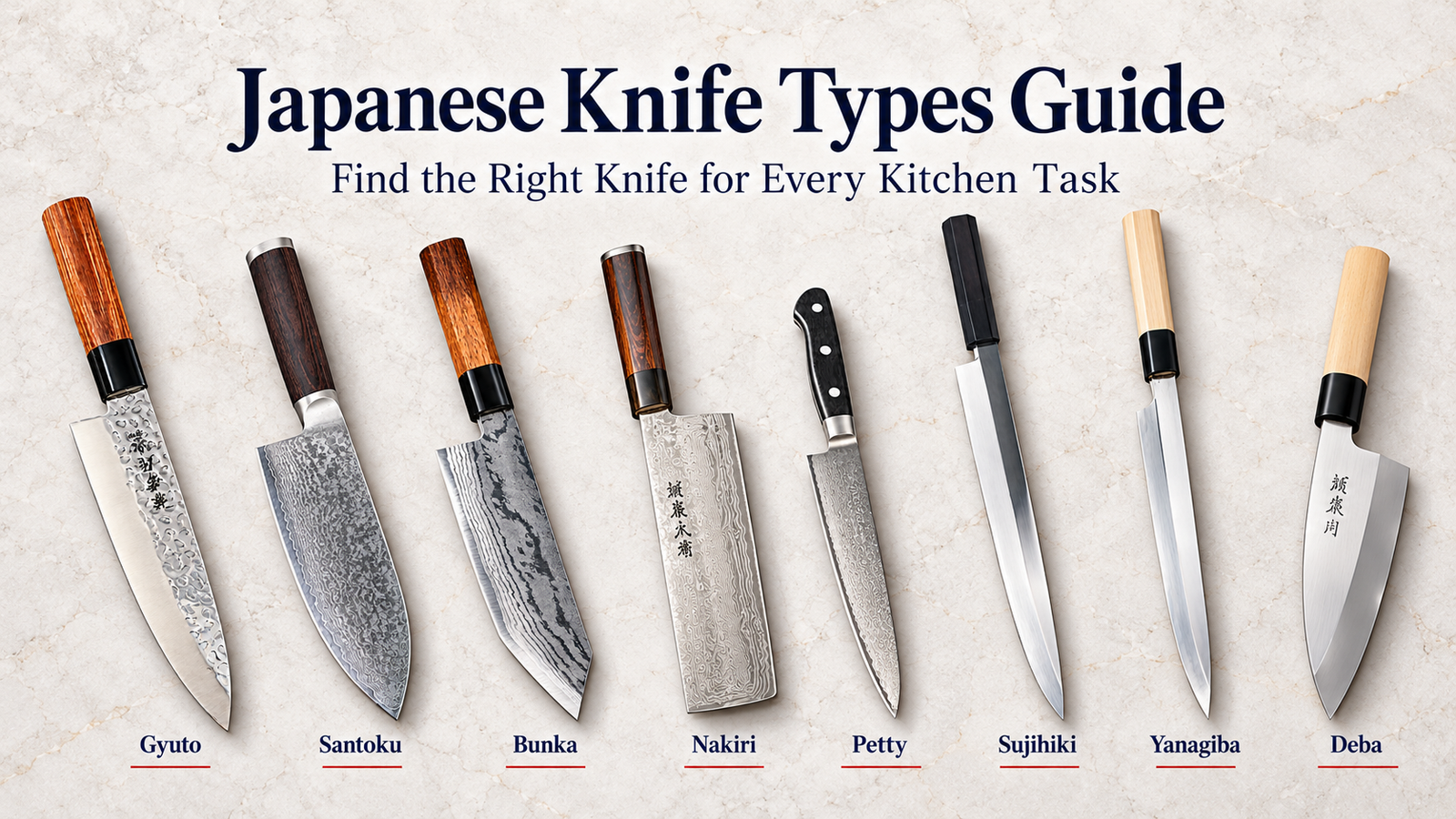
Japanese kitchen knives come in many shapes, each designed for a different style of cutting. Some, such as Gyuto, Santoku, and Bunka, are versatile enough for everyday cooking, while others are designed for vegetables, slicing, fish preparation, or precision work.
This Japanese knife types guide compares 10 essential styles — Gyuto, Santoku, Bunka, Nakiri, Petty, Sujihiki, Yanagiba, Deba, Kiritsuke, and Usuba — so you can understand their differences and choose the right knife for the way you cook.
Table of Contents
Japanese Knife Types Guide at a Glance
The best Japanese knife type depends on what you cook most often and how you prefer to cut. Use the table below to compare the most common styles by their main role and the tasks they handle best.
| Knife Type | Best For | Typical Role |
|---|---|---|
| Gyuto | Meat, vegetables, general prep | All-purpose chef’s knife |
| Santoku | Vegetables, meat, fish | Compact all-purpose knife |
| Bunka | General prep, precision work | Compact all-purpose knife with K-tip |
| Nakiri | Vegetables | Vegetable knife |
| Petty | Trimming, peeling, detail work | Small utility knife |
| Sujihiki | Slicing boneless meat and fish | Slicing knife |
| Yanagiba | Sushi, sashimi, raw fish | Traditional single-bevel slicer |
| Deba | Breaking down whole fish | Traditional heavy fish knife |
| Kiritsuke | Slicing and general prep | Long multi-purpose knife |
| Usuba | Precision vegetable work | Traditional single-bevel vegetable knife |
Main Japanese Knife Types
Gyuto
A Gyuto is one of the most versatile Japanese kitchen knives. Its pointed tip, relatively long blade, and slight curve make it well suited to meat, vegetables, herbs, slicing, chopping, and general meal preparation.
Common blade lengths include 180mm, 210mm, and 240mm. A Gyuto is a strong choice if you want one primary knife with more reach than a Santoku while still handling a wide range of everyday kitchen tasks.
Related guides:
Read the Gyuto Guide →
Best Gyuto Knives →
Santoku
A Santoku is a compact Japanese all-purpose knife designed for everyday preparation of vegetables, meat, and fish. Its relatively flat edge makes it especially comfortable for push cutting, straight chopping, and controlled up-and-down motions.
Santoku knives are commonly available in blade lengths around 165–180mm. Choose a Santoku if you want a versatile primary knife that feels shorter and easier to control than a Gyuto, especially in smaller kitchens or on compact cutting boards.
Related guides:
Read the Santoku Guide →
Best Santoku Knives →
Bunka
A Bunka is a versatile Japanese kitchen knife with a compact blade and a distinctive angled tip, often called a k-tip. It works well for vegetables, meat, fish, and everyday preparation, while the sharp tip makes it especially useful for precise cuts and detailed work.
Bunka knives are typically shorter and more agile than a Gyuto, making them a good choice for cooks who want all-purpose versatility in a more compact format. Choose a Bunka if you like the control of a Santoku but want a more pointed tip for precision work.
Related guide:
Read the Bunka Guide →
Nakiri
A Nakiri is a Japanese vegetable knife with a tall, rectangular blade and a flat cutting edge. It is designed for clean push cuts, straight chopping, and efficient preparation of vegetables, herbs, and other produce.
Nakiri knives are commonly around 165mm in length. Choose a Nakiri if vegetables make up a large part of your cooking and you want a dedicated knife that offers good knuckle clearance and precise contact with the cutting board.
Related guides:
Read the Nakiri Guide →
Best Nakiri Knives →
Petty
A Petty is a compact Japanese utility knife designed for trimming, peeling, fruit, garnishes, and other precise kitchen tasks. Its small blade offers excellent control where a larger chef’s knife can feel cumbersome.
Petty knives come in several short blade lengths and work best as a secondary knife rather than a primary all-purpose option. Choose one if you regularly handle small ingredients or detailed prep work.
Related guides:
Read the Petty Guide →
Best Petty Knives →
Sujihiki
A Sujihiki is a long, narrow Japanese slicing knife designed for clean, precise cuts through boneless meat, fish, roasts, and other proteins. Its long blade helps complete each slice in fewer strokes, reducing tearing and helping create smooth, even portions.
Choose a Sujihiki if you regularly carve roasts, portion cooked meats, or slice boneless fish and want a dedicated slicing knife with more reach than a Gyuto.
Related guide:
Read the Sujihiki Guide →
Yanagiba
A Yanagiba is a traditional Japanese slicing knife designed primarily for sushi, sashimi, and other raw fish preparation. Its long, narrow blade is made for smooth single-stroke slicing, helping preserve the texture and appearance of delicate fish.
Most Yanagiba knives use a traditional single-bevel edge and require more specialized technique than a typical double-bevel kitchen knife. Choose one if you regularly prepare sashimi or sushi and want a dedicated knife for precise raw-fish slicing.
Related guide:
Read the Yanagiba Guide →
Deba
A Deba is a traditional Japanese fish knife with a thick, heavy blade designed for breaking down whole fish, including removing heads, working around joints, and filleting. Its substantial construction provides the strength needed for fish butchery while still allowing controlled, precise cuts.
A Deba is more specialized than an everyday chef’s knife and is best suited to cooks who regularly prepare whole fish. It is not intended for chopping through large, hard bones like a Western cleaver.
Related guide:
Read the Deba Guide →
Kiritsuke
A Kiritsuke is a long Japanese knife with a distinctive angled tip. The name can refer to traditional single-bevel Kiritsuke knives or modern double-bevel versions often called Kiritsuke Gyuto. Both offer good reach and precise tip work, while traditional versions generally require more specialized technique.
Usuba
An Usuba is a traditional Japanese vegetable knife with a tall, rectangular blade designed for precise vegetable preparation, thin slicing, and decorative cuts. It offers excellent control for skilled technique, but its specialized profile makes it better suited to experienced users than to someone choosing a first all-purpose Japanese knife.
Double-Bevel vs Traditional Single-Bevel Japanese Knives
Many Japanese kitchen knives used for everyday cooking are double-beveled, while several traditional specialist knives use a single-bevel edge. The main differences are in edge geometry, ease of use, sharpening, and the tasks they are designed for.
| Feature | Double-Bevel | Single-Bevel |
|---|---|---|
| Common Examples | Gyuto, Santoku, Bunka, Nakiri, Petty, Sujihiki | Yanagiba, Deba, Usuba |
| Edge | Sharpened on both sides | Primarily sharpened on one side |
| Best For | Everyday cooking | Specialized fish and vegetable work |
| Ease | Easier for most home cooks | More technique required |
| Care | Generally simpler | More careful sharpening and handling |
Note: Traditional Kiritsuke knives are typically single-bevel, while many modern Kiritsuke-style Gyuto knives use a double-bevel edge.
For most home cooks, double-bevel Japanese knives are the more practical starting point. Traditional single-bevel knives make the most sense when you regularly perform the specialized tasks they were designed for and are comfortable with their sharpening and handling requirements.
Which Japanese Knife Type Should You Choose?
If you are still deciding, start with the tasks you perform most often and how much versatility you need. Use the shortcuts below to narrow down the best fit.
- Choose a Gyuto if you want one versatile main knife with good reach for meat, vegetables, and general prep.
- Choose a Santoku if you prefer a shorter, easy-to-control all-purpose knife for everyday home cooking.
- Choose a Bunka if you want compact all-purpose versatility with a sharp k-tip for precise cuts and detail work.
- Choose a Nakiri if vegetables make up a large part of your cooking.
- Choose a Petty if you need a small secondary knife for trimming, peeling, fruit, garnishes, and precise work.
- Choose a Sujihiki if you frequently slice boneless meat, roasts, or fish and want long, clean cuts.
- Choose a Yanagiba if you regularly prepare sushi or sashimi and want a traditional single-bevel slicing knife.
- Choose a Deba if you regularly break down whole fish and need a strong, specialized fish knife.
- Choose a Kiritsuke if you are comfortable with a more specialized long-blade profile for slicing and precise prep.
- Choose an Usuba if you use advanced Japanese vegetable-cutting techniques and want a traditional single-bevel vegetable knife.
For most first-time buyers, a Gyuto or Santoku remains the most practical starting point because both can handle the majority of everyday kitchen tasks.
Related guides:
Compare Gyuto vs Santoku →
Read the Japanese Knife Buying Guide →
Frequently Asked Questions
For most beginners, a Gyuto or Santoku is the best place to start. Choose a Gyuto for more reach and versatility, or a Santoku if you prefer a shorter, easier-to-control knife.
A Gyuto is generally longer and offers more reach for slicing and general prep, while a Santoku is shorter and easier to control. Both are versatile all-purpose knives suitable for everyday cooking.
Both Bunka and Santoku knives are compact, versatile Japanese kitchen knives suited to everyday cooking. The main difference is the tip shape: a Bunka usually has a sharp angled k-tip that offers more precision for detailed cuts, while a Santoku typically has a rounded or sheepsfoot-style tip that feels more forgiving and straightforward for general prep.
A Nakiri is one of the best Japanese knives for dedicated vegetable preparation because of its tall blade and flat cutting edge. A Santoku is a better choice if you also want to prepare meat and fish with the same knife.
A Sujihiki is ideal for slicing boneless meat, roasts, and fish with long, clean strokes. For traditional sashimi preparation, a Yanagiba is the more specialized option.
No. A Gyuto or Santoku can handle most everyday kitchen tasks on its own. Specialized knives such as Nakiri, Petty, or Sujihiki are useful additions when you regularly perform specific types of prep.
Where to Buy Authentic Japanese Knives
When buying a Japanese knife online, choose retailers that clearly list the maker, steel, blade size, handle, country of origin, shipping terms, and return policy. Transparent product information makes it easier to compare knives accurately and avoid poor-quality or misleading listings.
Continue Reading
Now that you understand the main Japanese knife types, these guides can help you compare your options, choose the right knife, and learn more about Japanese knife steel.
Explore All Japanese Knife Types →
Japanese Knife Buying Guide →
Compare Gyuto vs Santoku →
Explore Japanese Knife Steels →