
Japanese knife steel affects edge retention, corrosion resistance, sharpening, toughness, and overall maintenance. But steel names alone do not tell the whole story — heat treatment, blade geometry, and how you use the knife can matter just as much.
This Japanese knife steel guide compares stainless, carbon, and powdered steels, including VG-10, AUS-10, SG2/R2, Aogami, Shirogami, and HAP40, so you can understand the trade-offs and choose the steel that best matches your cooking style, maintenance preferences, and budget.
Table of Contents
Japanese Knife Steel Guide: What Really Matters
When comparing Japanese knife steels, look beyond hardness alone. Edge retention, corrosion resistance, sharpening difficulty, toughness, and maintenance all matter, while heat treatment and blade geometry can change how the same steel performs.
For most home cooks, the best steel is not necessarily the hardest or most expensive. The better choice is the one that gives you the balance of sharpness, durability, corrosion resistance, and maintenance that fits how you cook.
| Factor | What It Means | Why It Matters |
|---|---|---|
| Edge Retention | How long the edge stays sharp | Reduces sharpening frequency |
| Corrosion Resistance | Resistance to rust and staining | Makes daily maintenance easier |
| Sharpening Difficulty | How easy the steel is to sharpen | Affects home maintenance |
| Toughness | Resistance to chipping and damage | Makes the knife more forgiving |
| Hardness | Usually measured using HRC | Influences edge retention and brittleness |
Use these factors together rather than choosing a knife based on steel name or HRC alone.
Main Types of Japanese Knife Steel
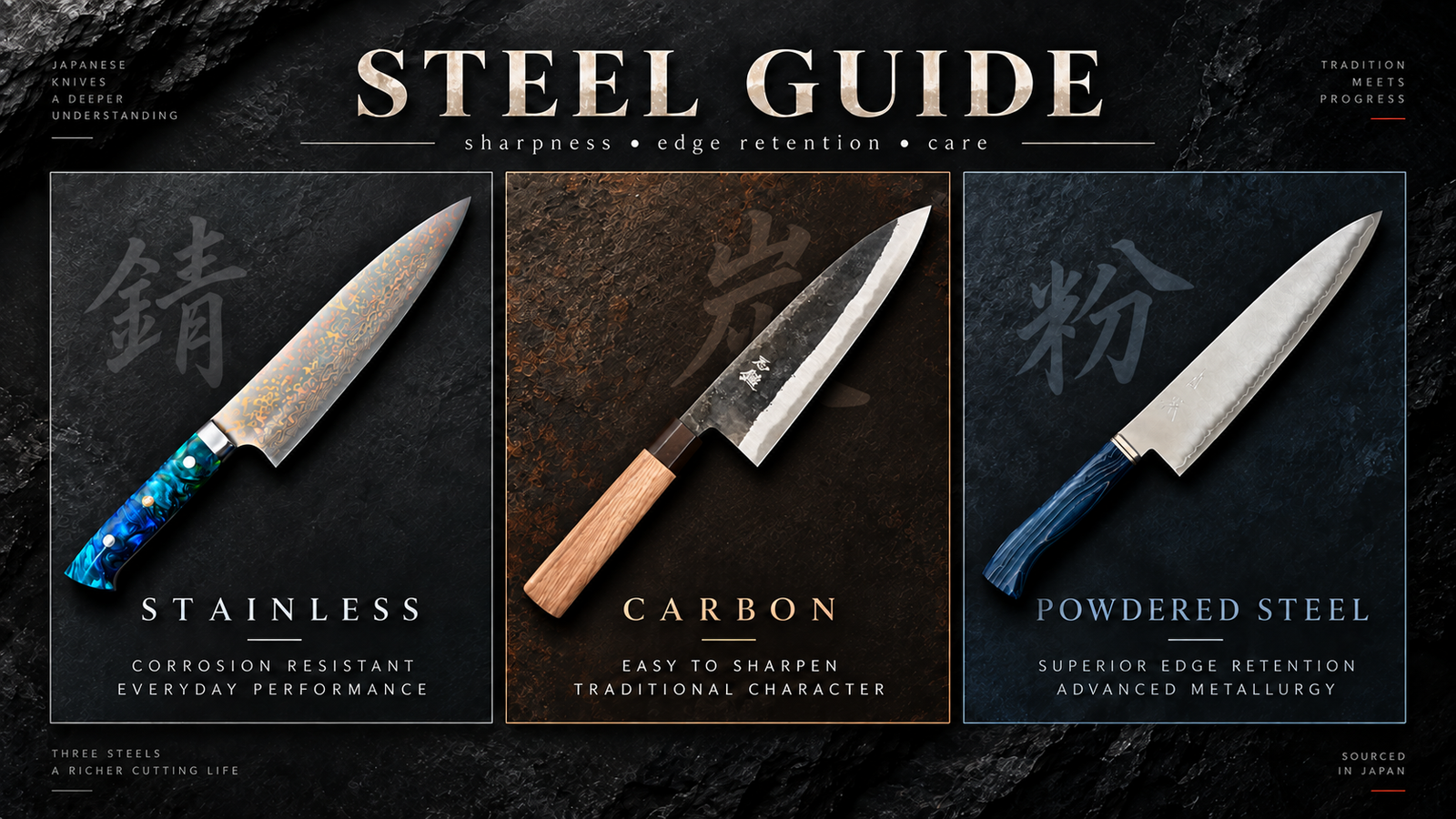
Japanese knife steels are commonly discussed as stainless, carbon, or powdered steels. Each has different strengths, and the best choice depends on how much maintenance you want, how often you are willing to sharpen, and how strongly you prioritize edge retention.
Stainless steel is generally easier to maintain, carbon steel is valued for responsive sharpening and a refined edge, while powdered steels are often chosen for high hardness and long edge retention.
| Steel Type | Main Strength | Main Trade-Off |
|---|---|---|
| Stainless Steel | Corrosion resistance and everyday usability | Performance varies by the specific steel and heat treatment |
| Carbon Steel | Responsive sharpening and fine edge potential | Reactive and requires prompt cleaning and drying |
| Powdered Steel | High hardness and long edge retention | Can be harder to sharpen and often costs more |
Stainless Steel
Stainless steel is popular in Japanese kitchen knives because it combines good cutting performance with corrosion resistance and relatively easy maintenance. It is not completely rust-proof, but it generally requires less attention than traditional carbon steel.
Common stainless steels include VG-10 and AUS-10. Stainless steel is a practical choice for home cooks who want strong everyday performance without having to worry as much about patina, discoloration, or frequent rust prevention.
Carbon Steel
Carbon steel is valued for its sharpening response, fine edge potential, and traditional feel. Steels such as Aogami and Shirogami can take very refined edges and are widely used in Japanese kitchen knives.
The trade-off is reactivity. Moisture, salt, and acidic foods can cause patina, discoloration, or rust, so carbon steel should be cleaned and dried promptly after use. It is best suited to users who are comfortable with regular maintenance.
Powdered Steel
Powdered steel, also called powder metallurgy steel, is used in some high-performance Japanese knives because it can combine high hardness, fine structure, and strong edge retention.
Steels such as SG2/R2 and HAP40 are aimed at users who prioritize cutting performance and longer edge life. Depending on the steel and heat treatment, they can be more demanding to sharpen and are often found in higher-priced knives.
Popular Japanese Knife Steels
Several steel names appear repeatedly when shopping for Japanese kitchen knives. The steels below cover a useful range from approachable stainless options to reactive carbon steels and high-performance powdered steels.
VG-10
VG-10 is a widely used stainless steel in Japanese kitchen knives, known for balancing corrosion resistance, edge retention, and relatively straightforward maintenance. It is commonly found in mid-range knives aimed at home cooks and enthusiasts.
Choose VG-10 if you want a stainless knife that offers a noticeable step up in cutting performance without requiring the maintenance of traditional carbon steel. It is a strong all-around option for everyday use.
AUS-10
AUS-10 is a stainless steel often used in practical, value-focused Japanese knives. It offers good corrosion resistance, solid edge retention, and generally approachable sharpening compared with harder premium steels.
Choose AUS-10 if you want an easy-to-live-with stainless knife at a more accessible price point. It is particularly suitable for first-time buyers and everyday home cooking.
SG2 / R2
SG2, also known as R2, is a powdered stainless steel used in higher-performance Japanese knives. It is capable of high hardness and strong edge retention while still offering useful corrosion resistance.
Choose SG2/R2 if you prioritize longer edge life and refined cutting performance and do not mind paying more or spending additional time sharpening when the knife eventually needs attention.
Aogami (Blue Steel)
Aogami is a family of traditional Japanese carbon steels valued for fine edge potential, strong edge retention, and responsive sharpening. It is reactive, so it can develop patina and requires careful cleaning and drying.
Choose Aogami if you enjoy maintaining your knives and want the sharpening feel and cutting performance associated with high-quality carbon steel.
Shirogami (White Steel)
Shirogami is a traditional carbon steel known for its simple composition, fine edge potential, and excellent sharpening response. It can take a very refined edge but is highly reactive and requires consistent maintenance.
Choose Shirogami if sharpening performance and a very fine edge matter more to you than corrosion resistance or low-maintenance ownership.
HAP40
HAP40 is a high-performance powder metallurgy steel known for very high hardness and long edge retention. It is often used in knives aimed at users who want to sharpen less frequently and prioritize sustained cutting performance.
Choose HAP40 if edge retention is one of your highest priorities and you are comfortable with a steel that can be more demanding to sharpen and may cost more than mainstream stainless options.
What Does HRC Mean in Japanese Knives?
HRC refers to Rockwell hardness, a scale used to describe how hard a knife steel is after heat treatment. Higher HRC values can contribute to longer edge retention, but they can also make a blade less forgiving and more prone to chipping if used carelessly.
Do not choose a Japanese knife based on HRC alone. Steel type, heat treatment, blade geometry, toughness, and your cutting habits all affect real-world performance, so HRC is best used as one comparison point rather than a simple quality score.
| HRC Range | General Character |
|---|---|
| Around 58–60 | More forgiving and easier to maintain |
| Around 60–62 | Common balance of edge retention and durability |
| 63+ | Higher edge retention potential, but often less forgiving |
For most home cooks, a well-made knife around 60–62 HRC offers a practical balance of sharpness, durability, and maintenance.
Which Japanese Knife Steel Is Best for You?
The best Japanese knife steel depends on how much maintenance you want, how often you are willing to sharpen, and whether you prioritize corrosion resistance, easy sharpening, or maximum edge retention.
| Steel | Key Trait | Best For |
|---|---|---|
| VG-10 | Balanced & low maintenance | Home cooks wanting dependable stainless performance |
| AUS-10 | Easy-care & good value | First-time buyers and value-focused cooks |
| SG2 / R2 | Long edge retention | Users wanting premium stainless performance |
| Aogami | Sharp & responsive carbon steel | Enthusiasts comfortable with regular maintenance |
| Shirogami | Excellent sharpening response | Users who prioritize fine edges and sharpening feel |
| HAP40 | Maximum edge retention | Experienced users prioritizing long edge life |
- Choose VG-10 if you want a balanced stainless steel that is easy to live with.
- Choose AUS-10 if you want good everyday performance at a more accessible price.
- Choose SG2 / R2 if you want premium stainless performance and longer edge life.
- Choose Aogami or Shirogami if you enjoy sharpening and do not mind reactive carbon steel.
- Choose HAP40 if edge retention is your top priority and you are comfortable with more demanding sharpening.
For most home cooks, VG-10, AUS-10, or SG2/R2 are the easiest places to start. Carbon steels such as Aogami and Shirogami make more sense for users who value sharpening performance and are comfortable with extra maintenance.
Related guides:
Japanese Knife Buying Guide →
Best Japanese Knives for Beginners →
Explore Japanese Knife Types →
Frequently Asked Questions
For most beginners, stainless steels such as AUS-10 or VG-10 are practical choices because they offer good cutting performance with relatively easy maintenance. SG2/R2 is also attractive if you want longer edge retention and are comfortable spending more.
Not necessarily. Carbon steel can offer excellent sharpening response and fine edge potential, while stainless steel is easier to maintain and better suited to users who prioritize corrosion resistance.
SG2/R2 is a powdered stainless steel that is often hardened more and can offer longer edge retention, while VG-10 is a widely used stainless steel that balances performance, corrosion resistance, and easier ownership.
No. Higher HRC can improve edge retention, but it may also make a blade less forgiving. Heat treatment, blade geometry, toughness, and intended use matter just as much.
Among the steels covered in this guide, HAP40 and SG2/R2 are known for strong edge retention. Actual performance still depends on heat treatment, blade geometry, sharpening, and how the knife is used.
Where to Buy Authentic Japanese Knives
When buying a Japanese knife, choose retailers that clearly list the maker, steel, blade size, heat treatment or hardness when available, country of origin, shipping terms, and return policy. Transparent product information makes it easier to compare knives accurately and avoid misleading listings.
Continue Reading
Now that you understand the main Japanese knife steels, these guides can help you choose the right knife, compare knife types, and find beginner-friendly options.
Japanese Knife Buying Guide →
Explore Japanese Knife Types →
Best Japanese Knives for Beginners →