

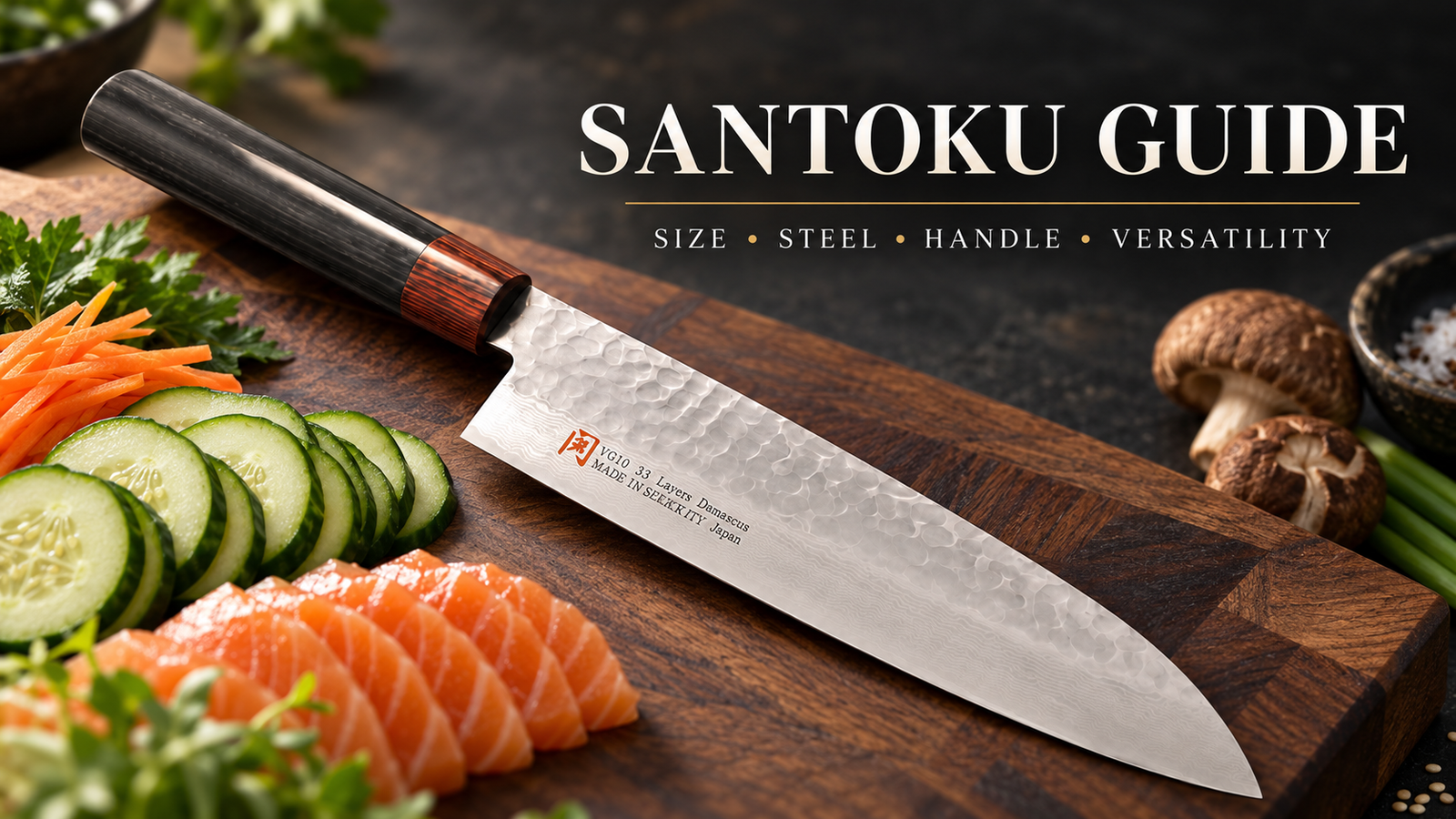
Santoku is one of the most versatile Japanese kitchen knives, combining a compact blade with a relatively flat cutting edge that works especially well for chopping, slicing, and everyday meal preparation.
Choosing the right Santoku depends on more than blade length alone. Steel, handle style, weight, balance, blade profile, maintenance, and budget can all affect how comfortable the knife feels and how well it fits the way you cook.
This Santoku buying guide explains what to compare before buying and helps you choose the blade length, steel, handle, and overall configuration that best fits your kitchen, experience level, and maintenance preferences.
Table of Contents
Santoku Buying Guide: What to Consider First
Santoku knives vary in blade length, steel, handle style, weight, balance, and blade profile. These factors directly affect how the knife feels in the hand, how easy it is to maintain, and which cutting techniques feel most natural.
For most home cooks, a 165–180mm stainless Santoku is a practical starting point because it offers a strong balance of control, versatility, and easy maintenance. From there, you can adjust the steel, handle, weight, and blade profile to match your preferences.
| Factor | What to Consider | Good Starting Point |
|---|---|---|
| Blade Length | Control and cutting space | 165–180mm for most home cooks |
| Steel | Maintenance and edge retention | Stainless for easier care |
| Handle | Grip and balance | Western or wa based on preference |
| Weight | Light vs substantial feel | Moderate weight for versatility |
| Blade Profile | Push cutting and chopping | Slightly flatter edge for control |
What Is a Santoku Knife?
A Santoku is a Japanese all-purpose kitchen knife designed for everyday food preparation. The name “Santoku” is commonly associated with “three virtues,” reflecting its versatility across tasks such as slicing, dicing, and chopping.
Santoku knives are generally shorter than Gyuto knives and often have a wider blade with a relatively flat cutting edge. This shape gives them good control for push cutting, straight chopping, and general meal prep, while the broad blade also makes it convenient to scoop and transfer chopped ingredients.
For home cooks who want one compact Japanese knife that can handle vegetables, meat, fish, and everyday prep without the extra length of a typical Gyuto, a Santoku is one of the most practical choices.
Choose the Right Santoku Blade Length
Santoku knives are commonly available in blade lengths around 150mm, 165mm, and 180mm. The right size depends mainly on your cutting-board space, hand size, and whether you prioritize compact control or additional cutting length.
A 150mm Santoku is compact and highly maneuverable, making it a good fit for smaller kitchens, limited cutting-board space, or cooks who prefer a lighter and easier-to-control knife.
A 165mm Santoku offers an excellent balance of control and cutting space for everyday home cooking. It is large enough for vegetables, meat, fish, and general meal prep while remaining noticeably more compact than a typical 210mm Gyuto.
A 180mm Santoku provides more reach and cutting area, which can be useful for larger ingredients and cooks who prefer a slightly more substantial all-purpose knife. However, it may feel less compact than shorter Santoku models.
For most first-time buyers, a 165–180mm Santoku is the safest starting range. Choose 165mm if compact handling matters more, or 180mm if you want additional cutting length without moving to a full-size Gyuto.
Choose the Right Santoku Steel
Santoku knives are available in stainless, carbon, and powdered steels, and each type offers a different balance of corrosion resistance, edge retention, sharpening, and maintenance.
Stainless steel is the easiest choice for most home cooks because it offers good corrosion resistance and relatively simple day-to-day care. Steels such as VG-10, AUS-10, and similar stainless options are practical for buyers who want dependable performance without worrying as much about rust or staining.
Carbon steel can offer excellent sharpening response and fine edge potential, but it is reactive and requires more careful cleaning and drying. Carbon Santoku knives are better suited to users who are comfortable with regular maintenance and do not mind patina developing over time.
Powdered steels such as SG2/R2 can offer stronger edge retention while still providing useful corrosion resistance. They are a good choice for buyers who prioritize longer edge life and are comfortable with harder sharpening and a higher price.
For most first-time Santoku buyers, stainless steel is the safest starting point. Choose carbon steel if sharpening feel and traditional performance matter more to you, or powdered steel if longer edge retention is a higher priority.
Choose the Right Santoku Handle
Santoku knives commonly use either Western-style handles or traditional Japanese-style wa handles. Neither style is automatically better; the right choice depends on which grip and balance feel most comfortable to you.
Western handles usually feel more familiar to cooks coming from standard chef’s knives and often provide a slightly heavier, more substantial grip. They are a practical choice if you prefer a conventional handle shape and a more neutral overall balance.
Wa handles are typically lighter and can make a Santoku feel more blade-forward or nimble, depending on the knife. They are popular with users who prefer a lighter handle and a more distinctly Japanese feel.
For a first Santoku, choose the handle style that feels most natural in your hand. If you are buying online and cannot test the knife first, a familiar Western-style handle can be the easier starting point for many cooks.
Weight and Balance
A Santoku’s weight and balance can change how the knife feels even when two models have the same blade length. Lighter knives often feel quicker and easier to maneuver, while heavier knives can feel more stable and substantial during cutting.
Balance also matters. Some Santoku knives feel more handle-heavy, while others are more blade-forward. Neither is automatically better; the best balance is the one that feels natural with your grip and cutting style.
For most home cooks, a moderately weighted Santoku with neutral or slightly blade-forward balance offers a practical mix of control, comfort, and versatility. If possible, compare the knife’s listed weight and handle construction before buying, especially when shopping online.
Blade Profile and Cutting Style
A Santoku typically has a flatter cutting edge than a Gyuto, which makes it especially well suited to push cutting, straight chopping, and controlled slicing.
Some Santoku knives have a little more curve toward the tip, while others stay flatter across most of the edge. A flatter profile gives more consistent board contact during chopping, while a slightly more curved profile can make the knife feel more versatile for mixed cutting techniques.
For most home cooks, a moderately flat Santoku profile offers the best balance of control and versatility. If you mainly use push cuts and straight chopping, choose a flatter edge. If you prefer a little more rocking motion, look for a Santoku with slightly more curve toward the tip.
What Is the Best Santoku for Beginners?
For most beginners, a 165–180mm stainless steel Santoku is the safest place to start. This size range offers enough cutting space for vegetables, meat, fish, and general meal prep while remaining compact and easy to control.
Look for a relatively easy-care stainless steel such as VG-10, AUS-10, or similar stainless options, along with a comfortable handle and moderate overall weight. A balanced, versatile Santoku is usually easier to learn with than an extremely thin, very hard, or highly specialized model.
Beginners should also prioritize straightforward maintenance and sharpening over maximum hardness or edge retention. A knife that is easy to control, clean, and maintain will usually be more useful than a higher-performance option that demands more careful technique.
If you are unsure where to start, choose a 165–180mm stainless Santoku with a comfortable handle and moderate weight. You can move toward carbon steel, powdered steel, or more specialized geometry later as you learn your preferences.
How Much Should You Spend on a Santoku?
The right Santoku budget depends on the steel, construction, finish, handle materials, and level of craftsmanship you want. A higher price does not automatically mean a knife will be a better fit for every cook.
Under $100, focus on reliable stainless steel, practical construction, and a versatile 165–180mm blade rather than premium finishes. This range can be a strong starting point for first-time buyers.
Under $200, you can access a wider range of steels, more refined construction, stronger edge retention, and better fit and finish while still staying below premium pricing.
Beyond $200, the differences become more dependent on maker, heat treatment, grind quality, handle materials, and personal preference. For most home cooks, the strongest value is usually found below $200, with solid options available even under $100.
Best Japanese Santoku Knives →
Best Japanese Knives Under $100 →
Best Japanese Knives Under $200 →
Common Santoku Buying Mistakes
One common mistake is choosing a Santoku based only on steel hardness, appearance, or premium materials. Blade geometry, heat treatment, balance, handle comfort, and overall fit can matter just as much in everyday use.
Another mistake is choosing a blade that does not match your kitchen space or cutting style. A 180mm Santoku can offer useful extra reach, but a 165mm model may feel more natural in a smaller kitchen or on a compact cutting board.
Beginners should also avoid extremely thin or very hard blades unless they are comfortable with careful technique. Twisting the blade, cutting frozen foods, or using hard cutting surfaces can increase the risk of chipping.
Finally, do not overlook maintenance. Carbon steel and some high-performance steels require more care than basic stainless options, so choose a Santoku that matches the amount of cleaning, drying, and sharpening you are willing to do.
Which Santoku Should You Choose?
The right Santoku depends on your kitchen space, experience, maintenance preferences, and how you normally cook. For most buyers, blade length and steel type are the easiest factors to use when narrowing down the choice.
| Type of Buyer | Santoku | Why |
|---|---|---|
| Beginner | 165–180mm stainless | Versatile, manageable, and easy to maintain |
| Small Kitchen | 150–165mm stainless | Compact and easy to control |
| Everyday Home Cook | 165–180mm stainless or SG2/R2 | Balanced size with strong all-purpose performance |
| Experienced User | 165–180mm carbon steel | Responsive sharpening and traditional performance |
| Edge Retention Priority | 165–180mm SG2/R2 | Longer edge life with good corrosion resistance |
For most first-time buyers, a 165–180mm stainless Santoku remains the safest all-around choice. Choose 150–165mm if compact handling matters most, or move toward carbon steel or powdered steel once you know your maintenance and sharpening preferences.
If low maintenance matters most, stay with stainless steel. Choose carbon steel if sharpening response and traditional performance matter more, or SG2/R2 if longer edge retention is a higher priority.
Frequently Asked Questions
For most home cooks, a 165–180mm Santoku offers the best balance of control, cutting space, and versatility. Choose 165mm if you prefer a more compact knife, or 180mm if you want a little more reach.
Yes. A 165–180mm stainless Santoku is one of the easiest Japanese knives for beginners because it is compact, versatile, and relatively easy to maintain.
Choose stainless steel if you want easier maintenance and better corrosion resistance. Choose carbon steel if you value sharpening response and traditional cutting performance and are comfortable with more careful cleaning and drying.
A Santoku is usually shorter, wider, and flatter through the edge, making it especially comfortable for push cutting and straight chopping. A Gyuto is generally longer and more curved, giving it more reach and making it better suited to longer slicing strokes and a wider range of cutting techniques.
You do not need a premium knife for your first Santoku. Good beginner-friendly options are available under $100, while spending up to $200 gives you access to a wider range of steels, construction quality, edge retention, and finishes.
Where to Buy Authentic Santoku Knives
When buying a Santoku, choose a retailer that clearly lists the maker, blade steel, blade length, country of origin, shipping terms, and return policy. Transparent product information makes it easier to compare knives accurately and avoid misleading listings.
If available, also check details such as hardness, handle style, blade thickness, and maintenance requirements so you can judge whether the knife matches your preferences before buying.
Sourced Japan maintains a list of trusted retailers that sell authentic Japanese kitchen knives and offer international purchasing options.
Continue Reading
If you are still comparing Santoku knives, these guides can help you compare specific models, understand how Santoku differs from Gyuto, and choose the steel that best fits your maintenance and performance preferences.
Best Japanese Santoku Knives →
Gyuto vs Santoku →
Japanese Knife Steel Guide →