

Affiliate Disclosure: Sourced Japan may earn a commission when you purchase through links on this page, at no additional cost to you. Our recommendations are based on independent research and editorial evaluation.
Japanese knives are known for their thin, precise edges, but even a well-made blade will eventually need sharpening. For most home cooks, a medium-grit whetstone and a consistent sharpening angle are enough to restore a dull edge without removing more metal than necessary.
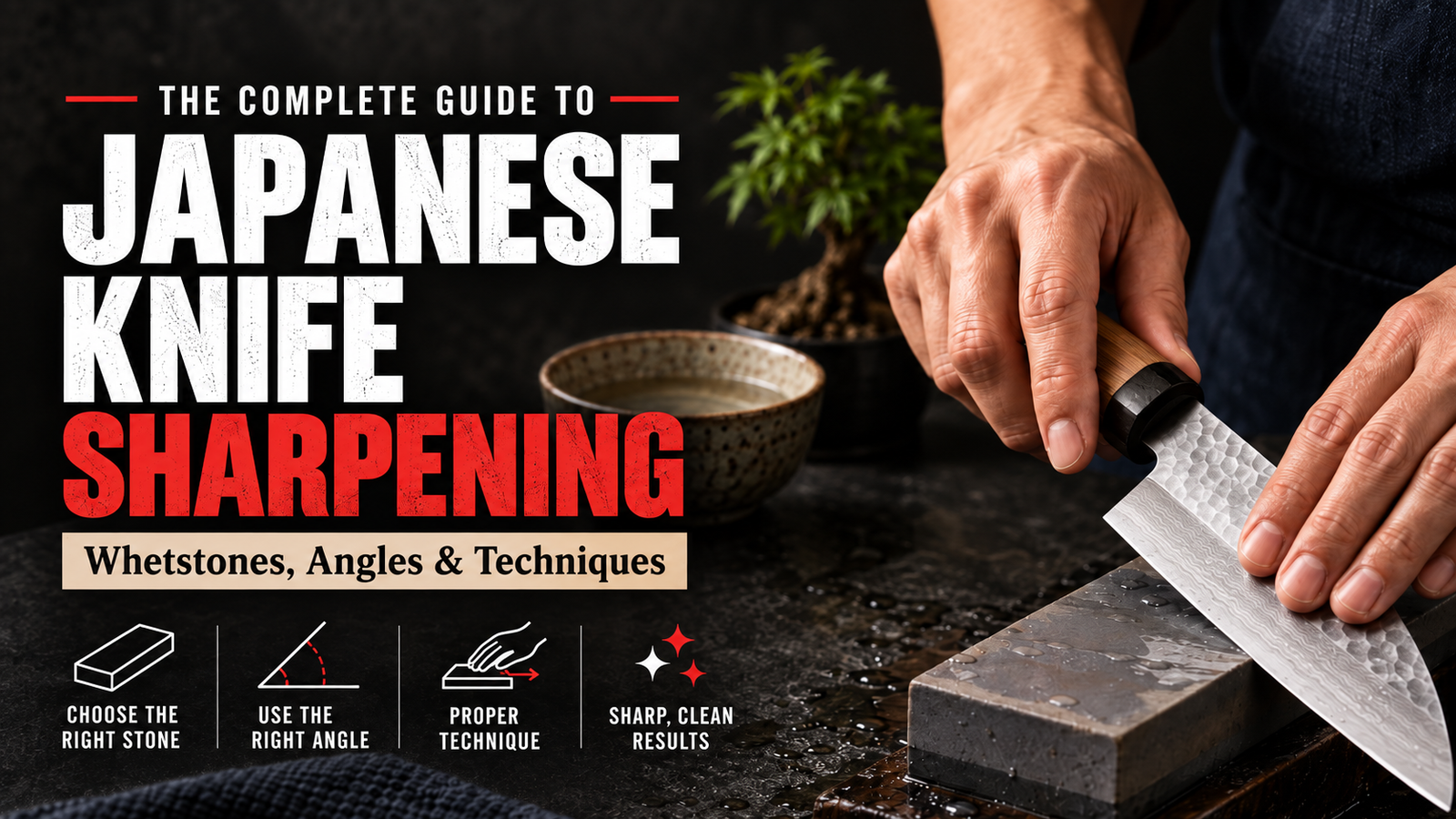
This guide explains how to choose the right whetstone grit, maintain a consistent angle, form and remove a burr, and sharpen both double-bevel and traditional single-bevel Japanese knives. It also covers sharpening frequency, honing rods, common mistakes, and what to look for when choosing sharpening tools.
Table of Contents
Japanese Knife Sharpening Guide: What to Know First
Before sharpening, check the knife’s bevel type, edge condition, and the grit you actually need. Double-bevel and single-bevel knives require different techniques, while a dull but undamaged edge usually needs far less metal removal than a chipped or damaged one. For routine sharpening, use light, controlled pressure and preserve the existing edge angle.
| Factor | What to Check | Why It Matters |
|---|---|---|
| Bevel Type | Double or single bevel | Determines sharpening technique |
| Edge Condition | Dull, chipped, or damaged | Helps choose the right grit |
| Whetstone Grit | Coarse, medium, or fine | Controls metal removal and refinement |
| Sharpening Angle | Match the knife geometry | Helps preserve the intended edge |
| Pressure | Light and controlled | Improves consistency and reduces mistakes |
How Sharp Should a Japanese Knife Be?
A Japanese kitchen knife should be sharp enough to cut food cleanly with minimal pressure. If the blade starts slipping on tomatoes, crushing herbs, or needing noticeably more force, the edge likely needs attention.
The ideal level of sharpness depends on the knife and how it is used. Thin Gyuto or Petty knives can benefit from a more refined edge, while knives used for tougher ingredients may need a slightly more durable finish. The goal is not the thinnest possible edge, but a balance of sharpness, control, and edge stability.
Whetstone Grits Explained
Whetstone grit describes how coarse or fine the abrasive surface is. Lower grit numbers remove metal faster, while higher grits refine and polish the edge.
Coarse stones, usually around 220–600 grit, are best for repairing chips, reshaping damaged edges, or restoring very dull knives. They remove metal quickly, so they should be used only when necessary.
Medium stones, around 800–2000 grit, are the most useful range for routine sharpening. For most home cooks, a stone around 1000 grit is a practical starting point for restoring a dull but undamaged Japanese knife.
Fine stones, around 3000 grit and above, are used to refine and polish an already sharpened edge. They can improve cutting feel and smoothness, but they are not essential for every knife or every sharpening session.
What Sharpening Angle Should You Use?

The right sharpening angle depends on the knife’s blade geometry, steel, and manufacturer recommendations. Many double-bevel Japanese kitchen knives are sharpened at roughly 10–15 degrees per side, but maintaining a consistent angle is more important than matching an exact number perfectly.
If the knife already has a well-established bevel, follow the existing edge angle rather than changing it dramatically. Use light, controlled pressure and preserve the original geometry whenever possible.
Traditional single-bevel knives such as Yanagiba, Deba, and Usuba require a different sharpening method and should not be treated like standard double-bevel knives.
How to Prepare a Whetstone
Before sharpening, check the manufacturer’s instructions for your whetstone. Some stones need to soak in water for several minutes, while splash-and-go stones only need their surface wet before use.
Place the stone on a stable, non-slip base and keep the surface wet while sharpening so metal particles and abrasive slurry do not build up excessively. If the stone becomes uneven over time, flatten it before the next sharpening session.
How to Sharpen a Japanese Knife Step by Step

Start with the whetstone secured on a stable surface and prepared according to the manufacturer’s instructions. Hold the knife at its existing edge angle and use light, controlled pressure.
Work from heel to tip so the entire edge contacts the stone evenly. Continue sharpening one side until a consistent burr forms along the opposite side of the edge.
Turn the knife over and repeat on the other side. Once both sides have been sharpened, reduce the pressure and use a few light alternating strokes to refine the edge and begin removing the burr. Move to a finer stone only if you want additional refinement.
Finally, rinse and dry the knife thoroughly, clean the whetstone, and test the edge carefully on food or paper. Avoid testing sharpness directly with your fingers.
How to Find and Remove the Burr
A burr is a very thin ridge of metal that forms on the opposite side of the edge as you sharpen. It indicates that you have reached the apex of the blade. Check for it carefully by moving a fingertip from the spine toward the edge—never along the edge itself.
Once a consistent burr runs from heel to tip, switch sides and repeat the sharpening process. After both sides are complete, reduce pressure and use light alternating strokes to remove the remaining burr. A finer stone can help refine the edge, but proper deburring matters more than simply polishing the blade.
How to Sharpen Double-Bevel Japanese Knives
Double-bevel Japanese knives are sharpened on both sides of the blade. Follow the existing edge angle, sharpen one side until a consistent burr forms from heel to tip, then repeat on the opposite side.
After both sides are sharpened, reduce pressure and use a few light alternating strokes to refine the edge and remove the burr. Most double-bevel knives are sharpened fairly evenly, but some use asymmetrical grinds, so follow the maker’s guidance when available.
How to Sharpen Single-Bevel Japanese Knives
Single-bevel Japanese knives such as Yanagiba, Deba, and Usuba are sharpened differently from standard double-bevel knives. Most of the sharpening work is done on the beveled side, while the back (ura) side is treated lightly to preserve its hollow-ground geometry.
Follow the existing bevel rather than creating a new angle, and use controlled pressure to avoid removing too much metal. Because single-bevel blades rely heavily on their original geometry, beginners should work slowly and follow the maker’s guidance whenever possible.
Whetstone vs Honing Rod
A whetstone and a honing rod serve different purposes. A whetstone removes a small amount of metal to restore or reshape the edge, while a honing rod is mainly used to realign or maintain an edge between sharpening sessions.
For most Japanese knives, a whetstone is the more important tool because harder, thinner edges do not always respond well to aggressive honing. If you use a honing rod, choose a fine ceramic rod and apply very light pressure. Avoid coarse steel rods unless the knife maker specifically recommends them.
How Often Should You Sharpen a Japanese Knife?
How often you should sharpen a Japanese knife depends on how frequently you use it, the steel, the cutting board, and how carefully the edge is treated. For most home cooks, sharpening every few months is often enough, but heavily used knives may need attention sooner.
Instead of following a strict schedule, watch for signs that the edge is losing performance. If the knife starts slipping on tomatoes, crushing herbs, or requiring more pressure than usual, it is probably time to sharpen.
Common Japanese Knife Sharpening Mistakes
Using too much pressure is one of the most common sharpening mistakes. Heavy pressure makes it harder to maintain a consistent angle and can remove more metal than necessary.
Another common problem is using the wrong grit or changing the sharpening angle during each stroke. A coarse stone can remove too much metal from a mildly dull knife, while a very fine stone may be too slow for a damaged edge. Consistency matters more than chasing an exact angle.
Finally, make sure the burr is fully removed, and do not sharpen a traditional single-bevel knife as if both sides were symmetrical. Incorrect technique can reduce cutting performance and alter the blade geometry.
Which Whetstone Should You Buy?
For most beginners, a medium-grit whetstone around 1000 grit is the best place to start. It is coarse enough to restore a normally dull edge while still providing enough refinement for everyday kitchen use.
If you want one stone to cover both sharpening and finishing, a combination stone such as 1000/3000 can be convenient. You do not need an extremely fine finishing stone unless you specifically want a more polished edge.
Also consider whether the stone is soaking or splash-and-go, along with its size, stability, and flattening requirements. For a simple first setup, a quality medium-grit stone, a secure holder or non-slip base, and a flattening tool are usually enough.
Frequently Asked Questions
A 1000-grit whetstone is the best starting point for most beginners. It is coarse enough to restore a normally dull edge while still leaving a refined finish suitable for everyday kitchen use.
Many double-bevel Japanese knives are sharpened at roughly 10–15 degrees per side. However, maintaining the knife’s existing bevel and keeping a consistent angle is more important than matching an exact number.
There is no fixed schedule. For many home cooks, every few months is enough, but the best indicator is cutting performance. If the knife starts slipping on food or requires noticeably more pressure, it is time to sharpen.
Not always. Harder Japanese steels can be more sensitive to aggressive honing. A fine ceramic rod may be suitable for some double-bevel knives, but a whetstone is generally the better tool for restoring a dull edge.
No. Single-bevel knives such as Yanagiba, Deba, and Usuba require a different technique because most sharpening is done on the beveled side, while the back is treated much more lightly to preserve the blade geometry.
Where to Buy Japanese Knife Sharpening Tools
If you’re ready to buy sharpening tools, look for retailers that clearly list whetstone grit, size, soaking requirements, and intended use. For most home cooks, a quality stone around 1000 grit is the best place to start, with a combination stone offering added flexibility for finishing.
Hocho Knife offers a broader selection of whetstones and sharpening accessories, while Yoshimune Knives carries a smaller collection of traditional sharpening stones. Check current availability and product specifications before ordering.
Continue Reading
Explore these related guides to learn more about caring for, choosing, and buying the right Japanese kitchen knife.
Japanese Knife Care Guide →
Best Japanese Knives for Home Cooks →
Best Japanese Knives for Beginners →